Apps Blog About
Web App · Portfolio · Open Source

Resonant Labs

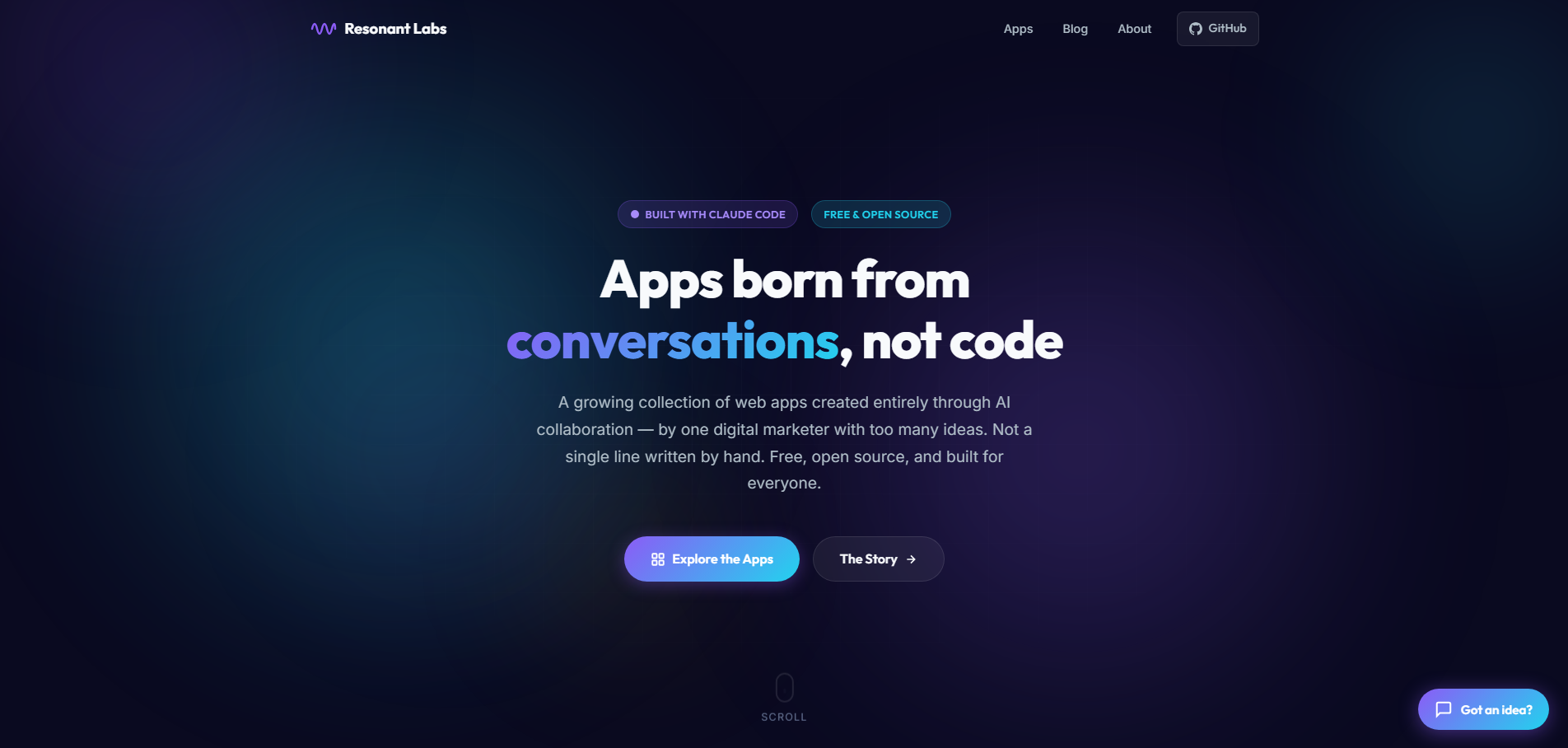
This very website — a full portfolio platform built entirely through AI conversation. Dark space theme, animated background, app cards, blog, cookie consent, comments, and newsletter. Not a single line written by hand.

🗓️ 1 Mar 2026 🤖 Built with Claude Code ⚖️ MIT Licensed
Resonant Labs website screenshot

What is it?

Resonant Labs is the portfolio site you're on right now — a fully custom-built website for showcasing AI-built apps. It serves as both a home for the projects and a demonstration of what's possible when you build through conversation instead of code.

What's inside

  • Deep dark space theme with animated breathing orbs across the full page
  • App cards rendered from a single data file — add a new app by editing one JSON-like file
  • Tag filtering across apps and blog posts
  • Full blog with reading progress, sidebar, share buttons, and comments
  • Cookie consent (ConsentKit) — built from scratch as part of this project
  • Comments via Cusdis — open-source, no account needed to comment
  • Idea submission chatbot — floating widget to collect app ideas from visitors
  • Newsletter via Buttondown
  • Google Tag Manager + Google Consent Mode v2
  • Fully responsive, accessible HTML

Why it's an app

Because it was built the same way as everything else here — through conversation, not code. It took the same skills, the same process, the same back-and-forth with Claude Code. A website is software. And this one got shipped the same way.

The starting point

I had three apps and nowhere to put them. GitHub repos don't tell a story. I wanted a place that presented the work properly — with screenshots, descriptions, a blog, and a way for people to reach me with ideas. So I described it to Claude Code and started building.

The build process

The site came together over several sessions. Each session started with a clear goal: build the hero section, build the app cards, build the blog layout, add the cookie consent. I described each component precisely — how it should look, how it should behave, what it should communicate.

It's important to say: this isn't just "prompt and get a website." I thought through every decision — the design language, the colour palette, the information architecture, the copy, the features. The AI built what I described. My thinking was the work. Claude Code was the tool that executed it.

"I built a tool I'd been paying for (ConsentKit), a chatbot to collect ideas, and a full blog — all as part of building the site itself. The scope just kept expanding because once you're in flow, everything feels possible."

The most interesting moment was realising this site had become its own project — worth documenting, worth listing as an app. It's not just a portfolio. It's a proof of concept for what one person with ideas and Claude Code can build.
🌐HTML / CSS
Vanilla JS
🍪ConsentKit
💬Cusdis
📊Google Tag Manager
📧Buttondown
📂GitHub Pages
🤖Claude Code

No framework, no build step

Pure HTML, CSS, and vanilla JavaScript. No React, no Vue, no bundler. The site is a collection of static files — fast, simple, and deployable anywhere. The design system lives in one CSS file. All app and post data lives in one JS file.

Open source

Full source on GitHub. Fork it, adapt it, use it as a starting point for your own portfolio. MIT licensed.

View Source on GitHub →

Got thoughts?

Questions about how it was built, ideas for what to add next — all welcome. No account needed.